
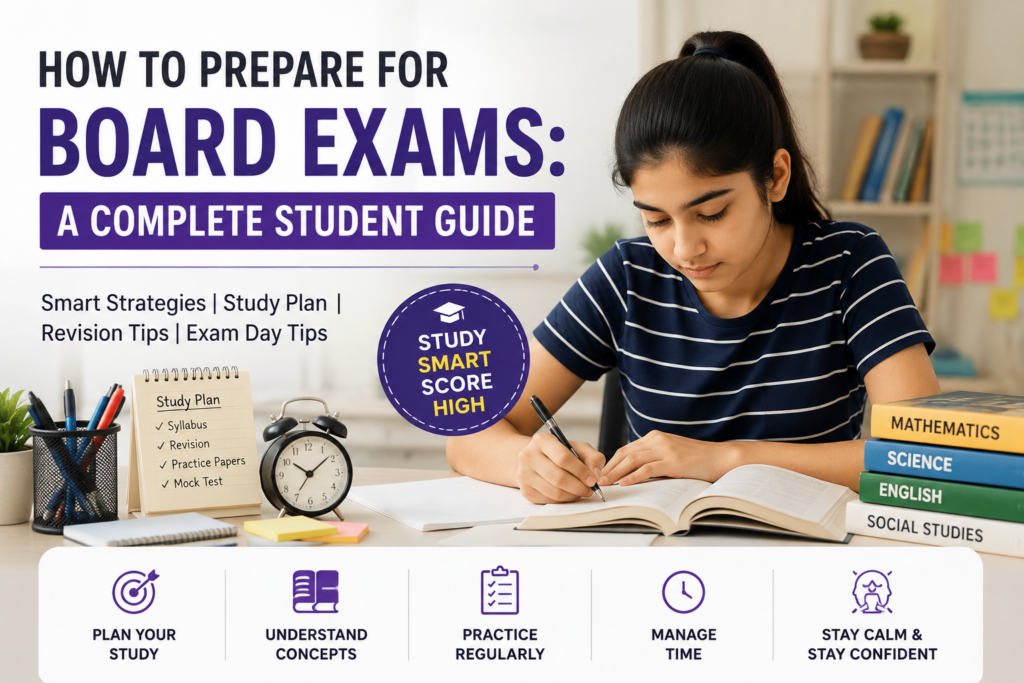
Board examinations are one of the most important milestones in a student’s academic journey. Whether you’re studying under the CBSE, ICSE, or State Board curriculum, these exams can influence your future education and career opportunities. While it’s natural to feel nervous, success in board exams doesn’t come from studying longer—it comes from studying smarter.
The good news is that every student can improve their performance with the right preparation strategy. In this guide, you’ll learn practical and proven techniques to prepare effectively, manage your time, reduce stress, and perform confidently on exam day.
1. Understand Your Exam Syllabus
Before opening your textbooks, take time to understand the complete syllabus. Knowing what topics are included helps you avoid wasting time on unnecessary chapters and allows you to focus on high-priority areas.
Make a checklist of every subject and chapter. As you complete each topic, mark it off. This simple habit keeps you motivated and helps you track your progress.
Tip: Download the latest syllabus from your respective board’s official website to ensure you’re studying the correct topics.

2. Create a Realistic Study Timetable
One of the biggest mistakes students make is studying without a plan. A well-balanced timetable helps you stay organized and reduces last-minute stress.
Your study schedule should include:
- Daily study sessions
- Short breaks after every 45–60 minutes
- Time for revision
- Practice tests
- Adequate sleep
Instead of studying one subject for the entire day, rotate between subjects to maintain interest and improve concentration.
3. Focus on Understanding, Not Memorizing
Board exams are increasingly testing conceptual understanding rather than simple memorization. Instead of trying to remember every sentence, focus on understanding the “why” and “how” behind each topic.
For example:
- Understand mathematical formulas before applying them.
- Learn scientific concepts through diagrams and examples.
- Connect historical events with their causes and consequences.
When you truly understand a concept, recalling it during exams becomes much easier.
4. Practice Previous Year Question Papers
One of the most effective preparation methods is solving previous years’ board exam papers.
This helps you:
- Understand the exam pattern
- Identify frequently asked questions
- Improve speed and accuracy
- Build confidence before the actual exam
Try solving papers within the official exam time limit. After completing each paper, review your mistakes carefully and focus on improving weak areas.
5. Revise Regularly
Revision is the key to long-term memory. Many students study a chapter once and move on without revisiting it. As a result, they forget important concepts before the exam.
A simple revision strategy is:
- Revise the same day after studying.
- Revise again after one week.
- Revise once more before the examination.

Creating short notes, flashcards, and mind maps can make revision faster and more effective.
6. Improve Time Management
Managing time during preparation is just as important as managing time during the exam.
Avoid spending too much time on a single difficult chapter. Instead:
- Finish easier topics first.
- Allocate more time to challenging subjects.
- Set daily goals.
- Avoid unnecessary distractions like excessive social media usage.
Common Mistakes Students Should Avoid
Many students lose valuable marks because of avoidable mistakes.
Some common mistakes include:
- Starting preparation too late
- Ignoring weak subjects
- Skipping revision
- Studying continuously without breaks
- Depending only on guidebooks
- Comparing themselves with other students
Conclusion
Board exam success is not achieved overnight—it is built through daily effort, smart planning, and consistent practice. By understanding your syllabus, following a realistic study plan, revising regularly, and taking care of your health, you can approach your exams with confidence.
Whether your goal is scoring above 90% or simply improving your performance, the right preparation strategy will help you reach it. Stay focused, believe in your abilities, and remember that every small step you take today brings you closer to success tomorrow.